Building Better Tuna Fisheries Through Data, Transparency, and Partnership
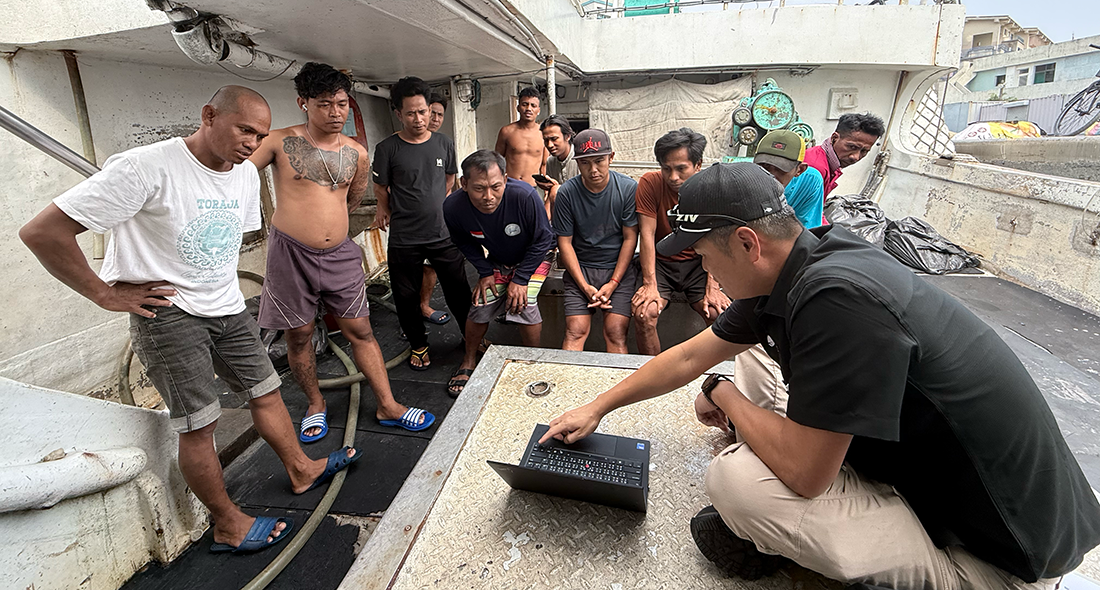
Kevin Lin (right), O2’s Taiwan Fisheries Manager, speaks with members of the crew aboard a Cheng Hung Seafood Frozen (CHSF) vessel during a Fishery Improvement Project (FIP) training.
Operating across some of the Pacific Ocean’s most remote waters, the Cheng Hung Seafood Frozen Produce Co., Ltd (CHSF) tuna fleet faces many of the challenges common to distant-water fisheries: limited observer coverage, complex management systems, and growing expectations around environmental and social responsibility.
Just a few years ago, CHSF’s sustainability work had largely stalled. Today, they are demonstrating measurable progress across environmental management, transparency, and social responsibility.
What changed? Sustained investment, a willingness to implement systems that work in real-world fishing conditions, and a trusted partnership with Ocean Outcomes.
Building on a Foundation, Accelerating Progress
In 2024, Ocean Outcomes assumed management and implementation of the CHSF Pacific Ocean Longline Tuna Fishery Improvement Project (FIP), bringing our hands-on approach and technical expertise shaped by years of experience working in complex fisheries around the world.
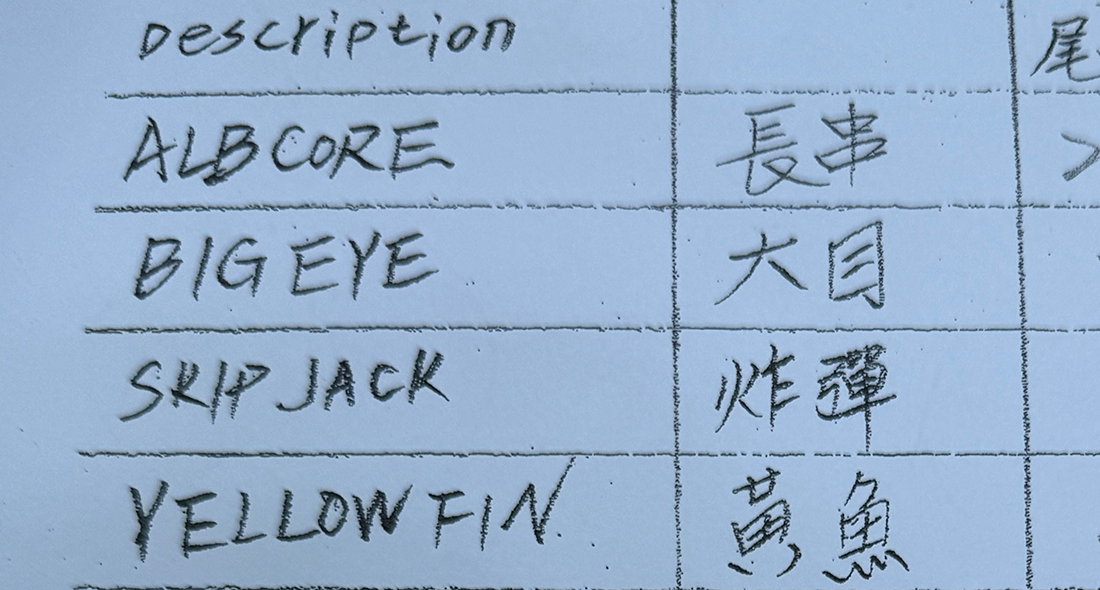 Accurate recordkeeping is an important part of fishery improvement. Through onboard engagement, captains are encouraged to verify catch records against electronic logbook submissions, supporting greater transparency and accountability throughout the fishery.
The 20 fishing vessels which are part of the FIP catch yellowfin, skipjack, bigeye, and albacore tuna. These vessels fish on the high seas and in the Solomon Islands Exclusive Economic Zone (EEZ) — making effective monitoring, data collection, and accountability especially challenging but critical.
While the target tuna stocks are generally considered healthy, long-term sustainability depends on strong management systems that can respond to changing conditions and prevent overfishing before it occurs. The FIP is bolstering the need for those robust management systems while working toward certification under the Marine Stewardship Council (MSC) Fisheries Standard by 2027.
Independent Review Shows Strong Progress
A recent independent three-year evaluation confirmed the FIP is making good progress on its sustainability work. The assessment, completed in October 2025, found meaningful improvements across stock management, environmental performance, and governance. Multiple indicators associated with the environmental performance of the fishery reached MSC passing thresholds, while several others demonstrated substantial progress. As a result, the FIP now holds an “A” rating on FisheryProgress.org.
Today, the FIP is addressing 27 of 28 environmental MSC performance indicators, while social responsibility efforts continue to advance through a combination of policy development, training, and worker engagement.
 Crew aboard a CHSF FIP vessel participate in the International Seafood Sustainability Foundation skipper best practice training and grievance process training.
Additionally, the FIP has participated in International Seafood Sustainability Foundation (ISSF) skipper best practice training, conducted with interpreters to ensure accessibility for migrant crew. To date, 18 of 20 FIP vessels are listed on the ISSF ProActive Vessel Register — a public vessel list that ISSF provides to foster transparency in tuna fishing — with the remaining two vessels to follow.
"The success of the FIP is not the result of any single organization. It reflects the willingness of CHSF, participating vessel owners, captains, crew, government agencies, and partners to stay engaged, address challenges openly, and keep improving year after year." — Kevin Lin, O2 Taiwan Fisheries Manager and CHSF FIP Lead
Electronic Monitoring: Building Transparency
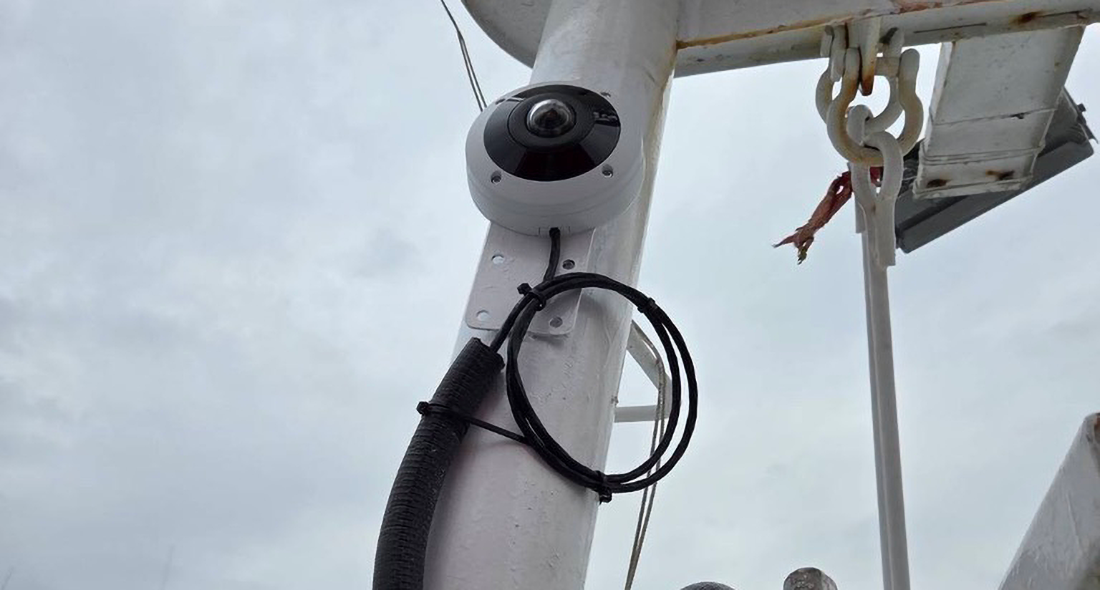 Electronic monitoring cameras provide a window into fishing operations at sea, helping improve transparency, data quality, and accountability across the CHSF FIP fleet.
One of the most notable areas of advancement has been the rollout of electronic monitoring (EM) systems within the fleet.
Prior to Ocean Outcomes’ involvement, the fleet had little independent observer coverage. This is common for distant-water longline fleets, but it presents a barrier to generating reliable data and demonstrating sustainable practices.
As part of the FIP work, EM systems were installed in late 2024 and by the end of 2025, four vessels were equipped with onboard cameras and monitoring technology. Data from two vessels has already been analyzed — covering more than 673,000 hooks deployed across 168 sets.
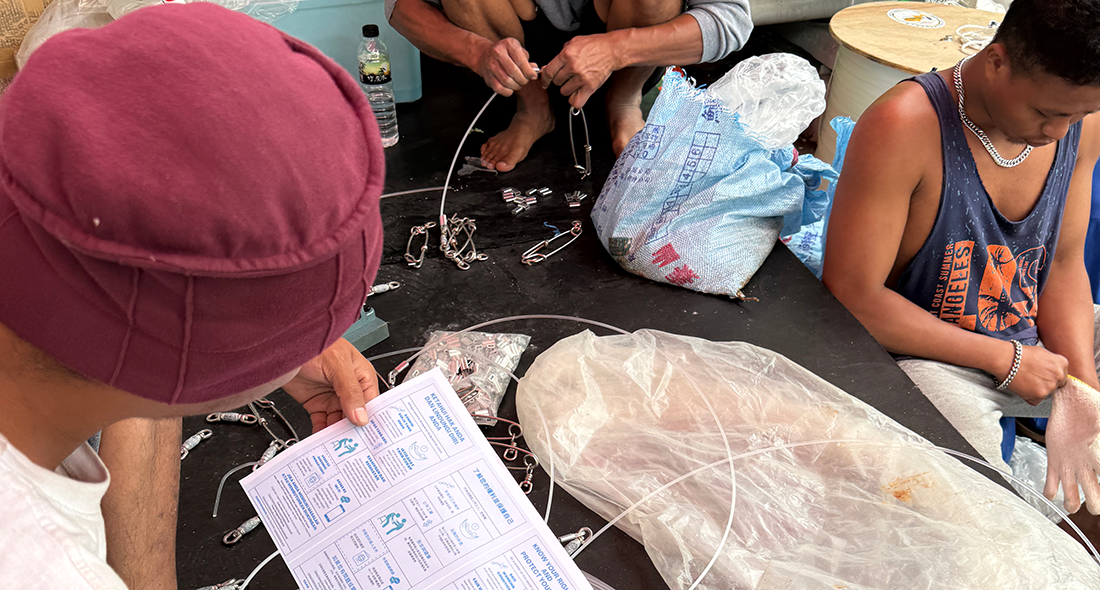
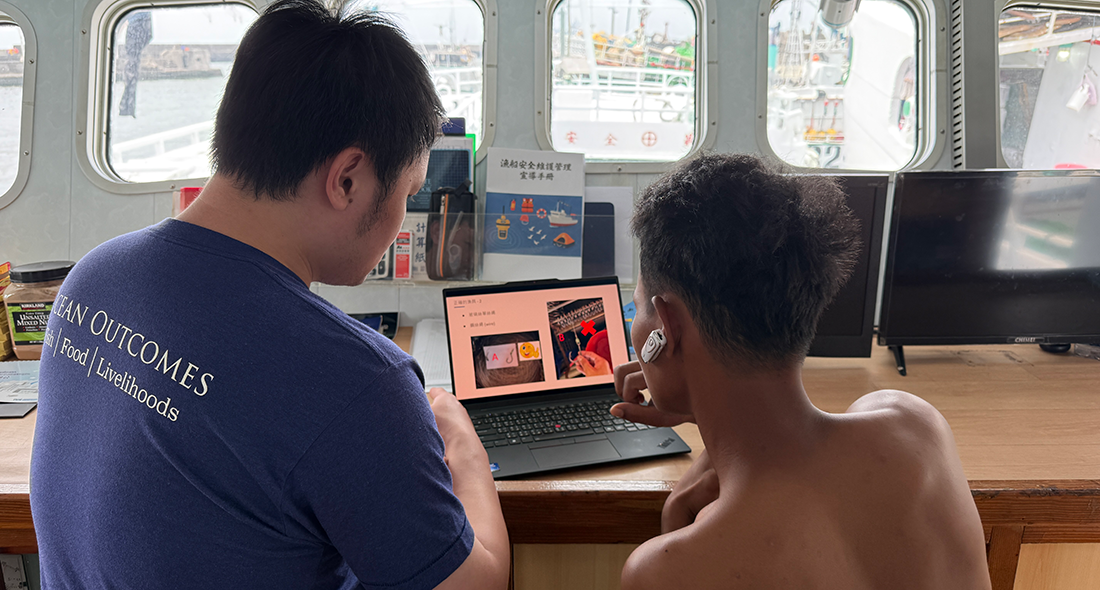 O2’s Asia Fisheries Coordinator, Ryan Xu, working with a member of the crew during a CHSF FIP training, highlighting best practices related to baiting hooks that can reduce unintended and unwanted bycatch.
The EM systems allow for around-the-clock visibility into fishing operations. Importantly, they are helping the fleet and CHSF better understand interactions with non-target species, including sharks, seabirds, turtles, and other protected marine life.
The three-year review noted that the FIP has demonstrated “a clear plan, strategy, and practical implementation of EM aimed at improving data collection” for endangered, threatened, and protected (ETP) species. While additional coverage will be needed to meet MSC Certification requirements, the review concluded that continued expansion of EM is highly likely to further improve the fishery's performance.
As part of the FIP, CHSF and participating vessels also adopted policies on shark finning and an ETP Conservation Policy. This helps ensure that crew and captains understand best practice handling requirements for any interactions at sea. These policies are now posted onboard all FIP vessels and visible to all crew.
Driving Change Beyond the Vessel
Improving a fishery isn’t only about what happens onboard — it also requires engagement in the management systems that govern tuna fisheries across the Pacific.
Over the past several years, the FIP has actively engaged with two tuna Regional Fishery Management Organizations (RFMOs) — the Western and Central Pacific Fisheries Commission (WCPFC) and the Inter-American Tropical Tuna Commission (IATTC).
"Lasting fishery improvement requires more than action on the water. It also requires active participation in the management systems that shape how fisheries are governed, monitored, and improved over time." — Ho-Tu Chiang, O2 Taiwan Fisheries Senior Manage and CHSF FIP Lead
Working alongside industry representatives, government agencies, and conservation partners, the project has led CHSF to advocate for stronger harvest strategies and management measures designed to keep tuna populations healthy over the long term.
This advocacy work has contributed to tangible results at the RFMO level. IATTC has adopted a harvest strategy and control rules for North Pacific albacore, as well as interim reference points for skipjack tuna. Several tuna stocks fished by FIP vessels now meet MSC’s highest performance thresholds for harvest management, a significant step forward from where the fishery stood just a few years ago.
Putting People at the Center of Fishery Improvement
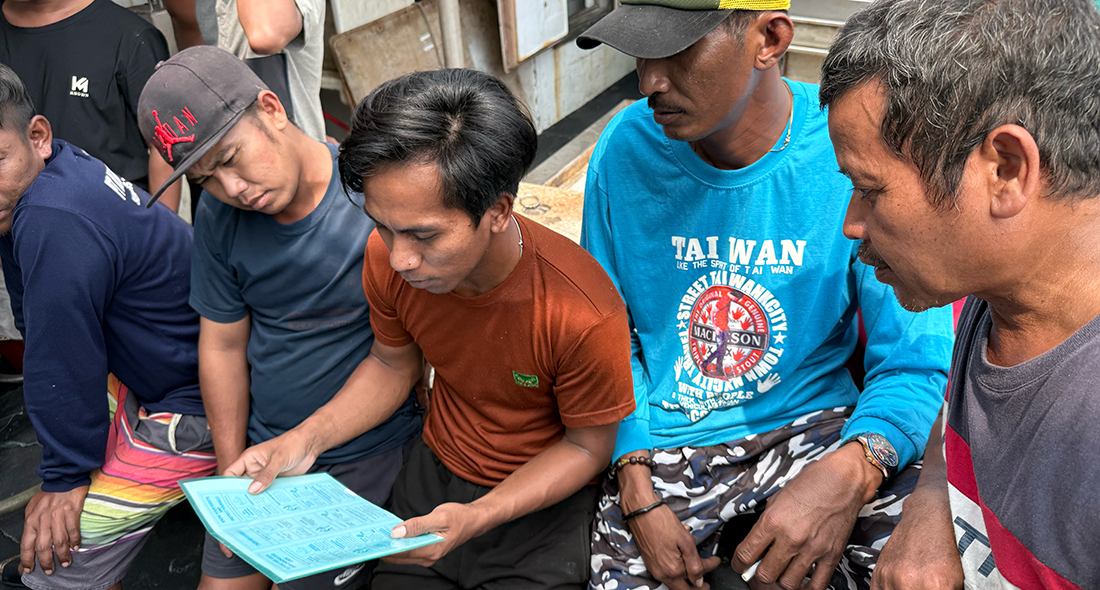 Crew members review training materials covering worker rights, responsibilities, and access to grievance mechanisms aboard a CHSF FIP vessel.
Healthy fisheries depend on healthy working conditions. That’s why Ocean Outcomes integrates social responsibility into fishery improvement work from the start. We recognize protecting workers and protecting fish stocks are inseparable parts of building resilient, sustainable fisheries.
Like many distant-water fisheries around the world, the CHSF FIP fishery operates in a context where labor risks are elevated. Addressing these risks is an essential part of building a responsible and accountable seafood supply chain.
Under O2’s management, the FIP has implemented crew and captain training in Taiwan and the Solomon Islands, covering rights and responsibilities and grievance access. Ongoing social responsibility work with O2 addresses fisher rights training and awareness of grievance channels. Efforts to enhance onboard safety, first aid preparedness and recruitment processes remain key priorities within the broader social responsibility workplan of the FIP.
These efforts go beyond compliance. They are about creating systems that support the dignity, safety, and wellbeing of the people whose labor makes tuna fisheries possible.
What’s Next: Expanding the Partnership
Building on the progress achieved through the CHSF FIP, Ocean Outcomes and CHSF are expanding their partnership to support MSC certification efforts for CHSF tuna fisheries operating in both the Pacific and Indian Oceans. O2 will provide technical support throughout the MSC assessment process, helping coordinate with certification bodies, compile and submit evidence, engage fishery stakeholders, and develop action plans where additional improvements may be needed.
For now, the work continues: EM coverage will expand. Social responsibility efforts will continue to evolve and strengthen. Engagement in regional fisheries management will remain a priority. And the partnership will keep working toward a future where sustainability is backed not only by commitments, but by data, transparency, and measurable results.
After all, lasting change doesn't happen through a single project or certification milestone. It happens through years of collaboration, trust, and a shared commitment to doing things better.